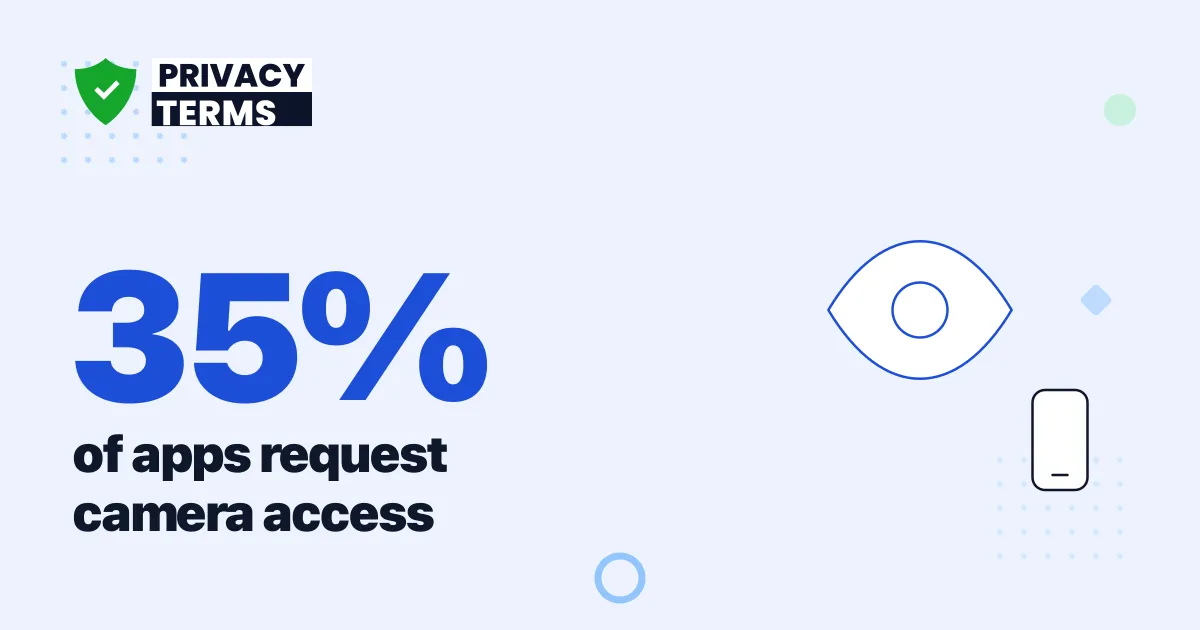
Camera access is the second most-requested sensitive permission on mobile today: 35% of the top apps NordVPN's Cybersecurity Research Lab studied in its 2026 mobile privacy research ask for it, trailing only location at 37%. On Android specifically, where the average app already requests nearly four times as many permissions as its iOS counterpart, that camera prompt sits inside Google's dangerous permission tier, the same classification NowSecure found triggering in 62% of the Android apps it assessed. The gap between how often camera access gets requested and how often it is actually needed is where most of the disclosure risk lives.
How many apps request camera access?
35% of the mobile apps NordVPN's Cybersecurity Research Lab studied in its 2026 research request camera access, based on an analysis of 103 top apps spanning 18 categories. That places camera second on the list of most-requested sensitive permissions, just behind location at 37% and well ahead of photo gallery access at 22% and microphone access at 16%.
Figure 1: Camera access trails only location among the permissions apps request most. Source: NordVPN Cybersecurity Research Lab, mobile app research, 2026.
| Permission | Share of apps requesting it | Android protection tier | Rank |
|---|---|---|---|
| Location | 37% | Dangerous | 1 |
| Camera | 35% | Dangerous | 2 |
| Photo gallery | 22% | Dangerous (scoped media access) | 3 |
| Microphone | 16% | Dangerous | 4 |
Source: NordVPN Cybersecurity Research Lab, mobile app research, 2026.
Location and camera lead the field for a straightforward reason: both permissions unlock features, maps, check-ins, photo uploads, video calls, that a large share of consumer apps genuinely ship. The gap between camera's 35% and microphone's 16% roughly tracks how many mainstream app categories have an obvious, user-facing reason to reach for each capability. A photo-sharing app justifying camera access is unremarkable; a flashlight app doing the same is a different conversation.
Camera access is common enough that most users no longer question the prompt, which is exactly why the disclosure behind it matters.
Is camera access more common on Android than iOS?
NordVPN's dataset does not break the 35% camera figure out by platform, but the surrounding numbers make Android's picture clear enough: Android apps in the same 2026 study averaged 19 total permissions per app, compared with just 5 on iOS, and 87% of Android apps requested at least one permission they did not need to function, against 60% of iOS apps.
Figure 2: Android apps average nearly 4 times as many permission requests as iOS apps. Source: NordVPN Cybersecurity Research Lab, mobile app research, May 2026.
That gap shows up in Android-specific research too. A 2025 academic study of 5,028 Android apps drawn from the AndroZoo dataset, led by Alkinoon and colleagues, found the average benign app requests 14 permissions, and separately confirmed that ACCESS_NETWORK_STATE, ACCESS_FINE_LOCATION, and ACCESS_COARSE_LOCATION were the three most frequently requested individual permission strings across 63,480 extracted requests. CAMERA did not crack that top three, but it remained one of the more frequently requested permissions the study tracked in its dangerous-permission breakdowns, consistent with camera sitting just behind location in NordVPN's separate ranking.
Android's own dangerous-permission classification adds another Android-specific data point: NowSecure's assessment of more than 378,000 Android apps through June 2025 found 62% carried at least one permission from that tier, which covers camera alongside location, microphone, contacts, and external storage. Of 335,000 iOS app assessments over the same period, only about 9.3% used a comparably dangerous entitlement.
Whichever dataset you use, the direction is consistent: an app is more likely to ask for your camera, and more likely to ask for something it does not strictly need, if it is running on Android.
Which apps request camera access without needing it?
Social networking apps top NordVPN's ranking for unnecessary permissions, averaging 10 permissions per app that its core functionality does not require, ahead of navigation apps at 9, dating apps at 6, and messaging apps at 5. Every one of those categories has an obvious, legitimate reason to want camera access, profile photos, video chat, scanning a document, which is exactly what makes an unjustified camera request easy to wave through during app review and easy for a user to overlook.
Figure 3: Social apps carry the most unneeded permissions of any category NordVPN measured. Source: NordVPN Cybersecurity Research Lab, mobile app research, 2026.
A separate manifest-file analysis of the 50 most downloaded Google Play apps, cited in NowSecure's June 2025 report, found an average of 11 dangerous permissions per app, with gaming apps averaging just 4 and apps in the Health and Fitness, Communications, and Productivity categories asking for the most. Camera access sits inside that dangerous-permission count for any app whose manifest declares it, whether or not the app's advertised feature set ever puts the camera on screen.
None of this means camera access is inherently a red flag. It means the permission is common enough, and the justification bar low enough in practice, that the gap between "requests camera" and "needs camera" rarely gets checked. If your app or site does ask users to enable a camera, for video calls, identity verification, or biometric login, that gap is exactly what a clear disclosure closes: a privacy policy generator built around current app permission categories keeps the stated purpose for camera access matched to what the app's manifest actually declares, rather than leaving it as boilerplate that drifts out of sync with the build.
Camera access earns its place on a permissions list only when a feature on screen explains it.
How does Android decide whether an app can use the camera?
Android does not treat every permission the same way. CAMERA sits in the dangerous tier, the group of permissions Android considers capable of touching sensitive data or core device functions, which means it cannot be granted silently at install the way a normal permission can.
Figure 4: Android's runtime approval path for a dangerous permission like camera. Source: Android Developers documentation, permission protection levels.
That runtime-approval model dates to Android 6.0 Marshmallow in 2015, which moved dangerous permissions, camera included, out of the old install-time bundle and into an explicit prompt the user sees the first time an app actually tries to use the capability. Android 11, released in 2020, added a further option specifically called out for camera, microphone, and location: a one-time grant that expires as soon as the user leaves the app, rather than persisting until manually revoked.
A smaller signature and special-access tier exists above dangerous permissions, reserved for system-signed apps or settings a user must toggle manually outside the standard prompt, but camera does not fall into that category on a typical consumer app. It stays squarely in the dangerous tier, which is also why the 62% dangerous-permission figure from NowSecure's research is a more useful signal than a raw permission count: an app with 20 permissions that are all normal-tier carries less real exposure than a 5-permission app where one of those five is camera.
The prompt users see for camera access is not a formality. It is Android's highest-friction approval path, reserved for exactly this kind of sensitive, device-level capability.
How has camera permission scrutiny changed since 2015?
Camera-specific privacy controls have tightened steadily since Android first moved the permission into its dangerous tier, and both major mobile platforms have added camera-specific safeguards on top of the basic approval prompt.
Figure 5: A decade of platform changes narrowing how, and how visibly, apps get camera access. Source: Android Developers documentation, Apple Newsroom, NowSecure (2025), NordVPN Cybersecurity Research Lab (2026).
The shift from a one-time install-time grant to a repeatable, revocable runtime prompt was the biggest structural change, but the visibility layer added since 2020 matters just as much in practice. Both Android 12 and iOS 14 added an always-visible indicator, a colored dot in the status bar, whenever an app is actively using the camera or microphone, turning a background permission into something a user can catch happening in real time. Android's Privacy Dashboard, introduced alongside that indicator, goes a step further by logging exactly which apps accessed the camera and when, giving users a record to check against what an app's privacy policy actually discloses.
None of these changes reduced how often apps ask for camera access. What changed is how visible that access became once it was granted.
The Bottom Line
Camera access is not a fringe permission. At 35% of studied apps, it trails only location among the permissions apps request most, and on Android, where the platform's own dangerous-permission tier catches it alongside location and microphone, 62% of assessed apps carry at least one permission from that same risk category. The practical test for any team shipping a camera-enabled feature is not whether the permission looks common, it clearly is, but whether the app's privacy policy names the feature that justifies it, states what gets captured, and says how long any footage or images are kept. Social networking, navigation, and dating apps already over-request at the highest rates of any category NordVPN measured, which is exactly the population most likely to be asking for camera access it cannot fully justify on review.
Frequently Asked Questions
How many apps request camera access? 35% of the top mobile apps NordVPN's Cybersecurity Research Lab studied in 2026 request camera access, the second most-requested sensitive permission behind location at 37%, and ahead of photo gallery access at 22% and microphone access at 16%.
Is camera access more common on Android than iOS? Android apps request permissions far more aggressively overall: 19 permissions per app on average versus 5 on iOS, and 87% of Android apps request at least one permission they do not need to function, compared with 60% of iOS apps, according to NordVPN's May 2026 research.
Which apps request camera access without needing it? Social networking apps top NordVPN's unnecessary-permission ranking at an average of 10 unneeded permissions per app, followed by navigation apps at 9, dating apps at 6, and messaging apps at 5, a category mix that overlaps heavily with apps offering photo, video, or profile-picture features.
Is the CAMERA permission considered risky on Android? Yes. Android classifies CAMERA as a dangerous permission requiring explicit runtime approval, the same tier as location and microphone, and NowSecure found 62% of the 378,000-plus Android apps it assessed through mid-2025 carried at least one dangerous permission.
Where the Numbers Come From
- NordVPN Cybersecurity Research Lab. (2026). "Mobile privacy: What do your apps want to know?" Analysis of 103 top apps across 18 categories, May 2026. Camera access requested by 35% of studied apps, versus 37% for location; Android averages 19 permissions per app versus 5 on iOS.
- NowSecure. (2025). "How Dangerous Mobile App Permissions Threaten Enterprise Security." Published 4 June 2025, based on assessments of 378,000-plus Android apps and 335,000 iOS apps over the prior year. 62% of Android apps carried at least one dangerous permission, versus 9.3% of iOS assessments with a dangerous entitlement.
- Alkinoon, A., Dang, T.C., Alghuried, A., et al. (2025). "A Comprehensive Analysis of Evolving Permission Usage in Android Apps: Trends, Threats, and Ecosystem Insights." Submitted to the Journal of Cybersecurity and Privacy, August 2025. Dataset of 5,028 apps (4,465 benign, 563 malicious) from AndroZoo, 2019 to 2023; 14-permission average for benign apps.
- Cybernews. Manifest-file analysis of the 50 most downloaded Google Play apps for dangerous permissions, cited in NowSecure's June 2025 report. Average of 11 dangerous permissions per app; gaming apps averaged 4.
- Android Developers. "Permissions on Android." Documentation covering protection levels, including the dangerous-permission runtime approval model introduced in Android 6.0 and the one-time grant option added in Android 11.
Note: All figures verified as of July 2026. NordVPN's 35% camera-access figure covers its full studied sample rather than an Android-only breakout; Android-specific context throughout this post, including the 19-permission average and the 62% dangerous-permission rate, is drawn from NordVPN's and NowSecure's separately reported platform splits. Figures are refreshed at least twice a year to track newer NordVPN and NowSecure editions.